Main points
Last update
Since 2015, deaths from non-communicable diseases (NCDs) before the age of 70 have fallen by 21 per cent. The decline in deaths due to cancer and cardiovascular diseases has had the greatest impact.
Non-communicable diseases are the leading cause of premature mortality among adults in both wealthy and many poor countries.
“Premature mortality” here means death before the age of 70. The non-communicable diseases included in these statistics are heart attacks, strokes and other cardiovascular diseases, cancer, diabetes and chronic pulmonary diseases, mainly chronic obstructive pulmonary disease (COPD).
Targets towards 2025 and 2030
In 2012, the World Health Organization (WHO) adopted a resolution to reduce premature mortality from non-communicable diseases by 25 per cent between 2010 and 2025. This target has since been changed to a 33 per cent reduction from 2015 to2030 and is included in the United Nations' global goals for sustainable development. Additionally, there are eight additional targets, as shown in the figure below. The nine targets are often referred to as the “NCD targets.”
In Norway, the number of premature deaths from non-communicable diseases declined from 212 per 100 000 inhabitants in 2015 to 167 in 2024, corresponding to a 21 per cent decrease.
A reduction of 21 per cent in premature mortality from 2015 to 2023 indicates that Norway is on track to reach the goal of a 33 per cent reduction by 2030, if the trend continues. A challenge for further reduction in mortality might be that Norway is not approaching the goal of reducing the population’s alcohol consumption. We are also not approaching the targets for reducing tobacco use among young people, or the reduction in the proportion of inactive individuals or halting the rise in obesity.
Norway: positive trends for four out of nine targets
The nine targets established by WHO to combat non-communicable diseases are shown in Figure 1. In addition to reducing premature mortality before the age of 70, which is target number 1, the goal is to reduce the four most important shared risk factors:
- Tobacco use
- Unhealthy diet
- Physical inactivity
- High alcohol consumption
There are also other targets related to blood pressure, obesity and diabetes, and access to treatment for everyone who needs it.
For Norway, the development appears to be positive for four out of the nine targets, as shown in Figure 1. For three targets, we have not managed to reverse the trend. This includes a 15 per cent reduction in physical inactivity, a 30 per cent reduction in salt intake, and halting the rise in obesity and diabetes. We are uncertain about the progress related to the target of a 20 percent reduction in harmful alcohol use. The target for a 30 percent reduction in overall tobacco use by 2025 was not achieved, but there has been a significant and very positive decline in daily smoking during the target period.
We need to closely monitor progress. In several areas, we need better data over time. This includes data on counselling to prevent heart attacks and strokes.
The nine NCD targets are just one of several indicators of the population's health status. For Norway, it is important to observe whether the positive trends occur among both women and men and across all social strata, or whether we are moving towards greater social health disparities.
Summarising table
Figure 1 below shows the nine targets and the status for Norway.
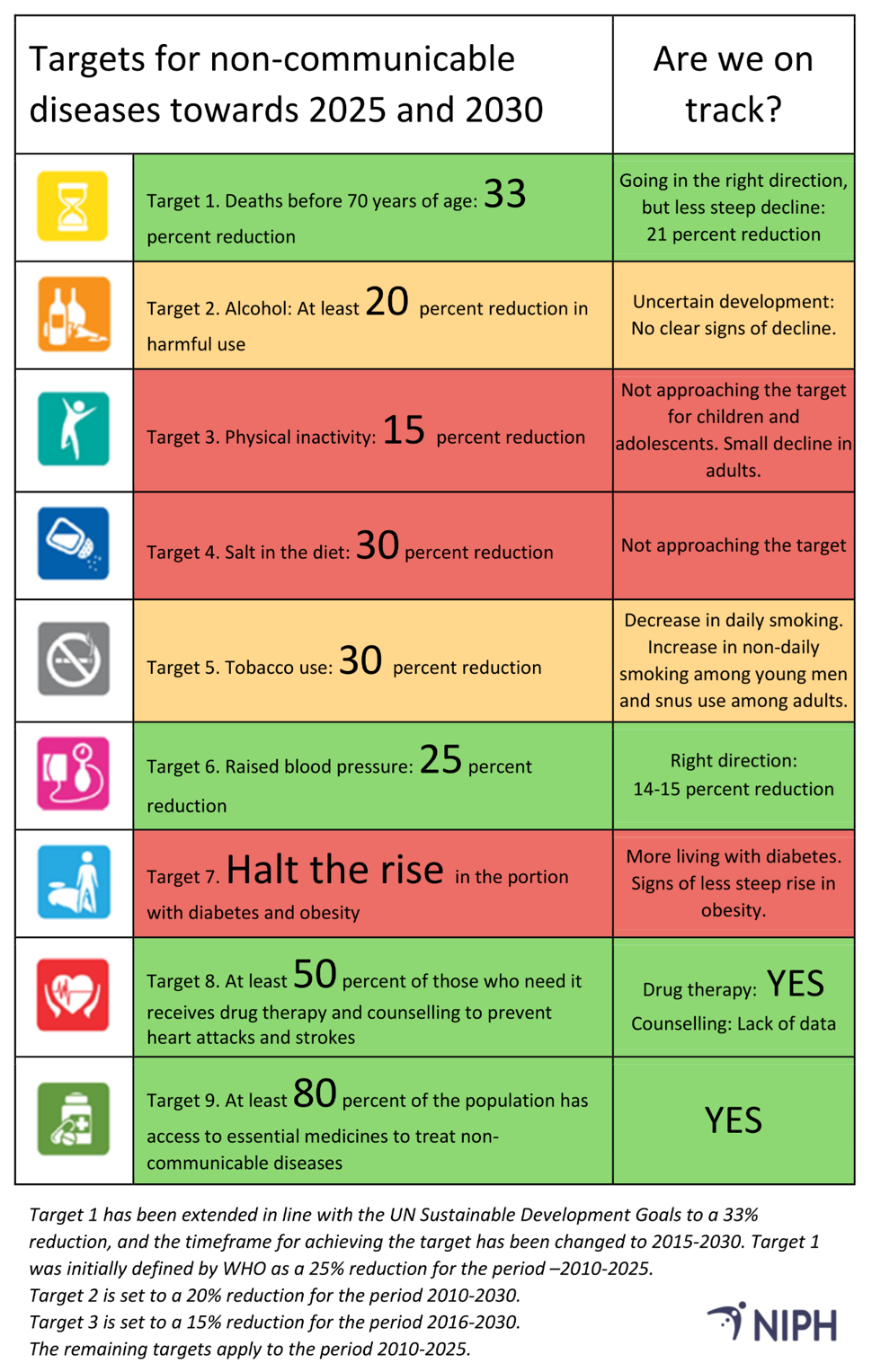
Comments on the table and links to relevant chapters:
Target 1. Premature mortality
- 21 per cent reduction in the proportion with premature deaths due to non-communicable diseases in the age group 30-69 years (2015-2024).
Target 2. Alcohol
- 7 per cent reduction in alcohol sales (2010-2024).
- No definite change in self-reported alcohol consumption (2012-2025).
- No definite change in the proportion reporting heavy episodic drinking (2012-2025).
- We lack valid indicators for alcohol-related diseases.
Target 3. Physical inactivity in adolescents and adults
- A small decline in the proportion of adults who are insufficiently physically active (inactive) 2009-2022.
- No change in the proportion of children and adolescents who are insufficiently physically active (inactive) in 2005, 2011 to 2018.
Target 4. Salt intake
- No change over time in salt intake in examinations in Nord-Trøndelag 2006/08, Tromsø 2015/16 and in Nord-Trøndelag 2017/19.
Target 5. Tobacco use in adolescents and adults from 2010 to 2025
Smoking, daily or non-daily:
- 48 per cent reduction in the proportion of adult males who smoke daily or non-daily.
- 58 per cent reduction in the proportion of adult females who smoke daily or non-daily.
- 34 per cent increase in the proportion young males who smoke daily or non-daily. This is driven by an increase in non-daily smoking. Daily smoking has decreased significantly (76 per cent decrease) and is now at a very low level (around 1%)
- 27 per cent increase in the proportion of young females who smoke daily or non-daily. This is driven by an increase in non-daily smoking. Daily smoking has decreased significantly (93 per cent decrease) and is now at a very low level (less than 1%).
Snus use (moist powder tobacco), daily or non-daily (2010-2024):
- 44 per cent increase in the proportion of adult males who use snus daily or non-daily.
- 181 per cent increase in the proportion of adult females who use snus daily or non-daily.
- No clear change in the proportion of young males who use snus daily or non-daily.
- No clear change in the proportion of young females who use snus daily or non-daily.
Target 6. Raised blood pressure
- 15 per cent reduction in the proportion of adult males with raised blood pressure in Nord-Trøndelag during 2006-2019.
- 14 per cent reduction in the proportion of adult females with raised blood pressure in Nord-Trøndelag during 2006-2019.
- 24 per cent reduction in the proportion of adult males with raised blood pressure in Tromsø during 2008-2016.
- 25 per cent reduction in the proportion of adult females with raised blood pressure in Tromsø during 2008-2016.
Target 7. Diabetes and obesity
- 54 per cent rise in the proportion of males who have diabetes in Tromsø.
- 63 per cent rise in the proportion of females who have diabetes in Tromsø.
Obesity in adolescents and adults:
- No change in the proportion of children and adolescents with obesity (2010-2019).
- 10 per cent rise in the proportion of adult males with obesity in Nord-Trøndelag during 2006-2019.
- 2 per cent rise in the proportion of adult females with obesity in Nord-Trøndelag during 2006-2019.
- 26 per cent rise in the proportion of adult males with obesity in Tromsø during 2007-2016.
- 18 per cent rise in the proportion of adult females with obesity in Tromsø during 2007-2016.
Target 8. Drug therapy and counselling to prevent heart attacks and strokes.
In Norway the proportion receiving drug therapy is much higher than 50 per cent. We lack data on counselling.
Target 9. Access to drug therapy for non-communicable diseases (NCD medicines).
In Norway, the proportion of individuals with access to NCD medicines is close to 100 per cent.
National group
In Norway, a national group was established to collect and present data on the nine targets. The group forms the editorial team for this publication. The data have been published on the Norwegian Institute of Public Health’s web pages in the form of indicators. Each indicator is described in a separate chapter of this web publication.
There are 25 indicators in total, of which some are directly linked to the NCD targets, while others are additional indicators that underpin the NCD targets more indirectly.