Norwegian Breast Cancer Registry
Article
|Last update
4460 women were diagnosed with breast cancer for the first time in 2025. The volume of surgeries at the various hospitals performing breast cancer surgery in Norway still varies significantly.
Summary from the annual report 2025
Pathology
Coverage of pathological variables is generally high (95 %). After the introduction of the Prosigna test and ROR score, Ki67 is conducted less frequently, with coverage below 80 %, although it should still be conducted. Some pathology departments assess Ki67 first and use Prosigna for intermediate values. There is variation between departments in histological grading, an important factor for adjuvant treatment decisions, highlighting the need for quality assurance. The waiting time for pathology results after surgery is currently too long, potentially leading to a delay in the start of adjuvant therapy.
Surgery
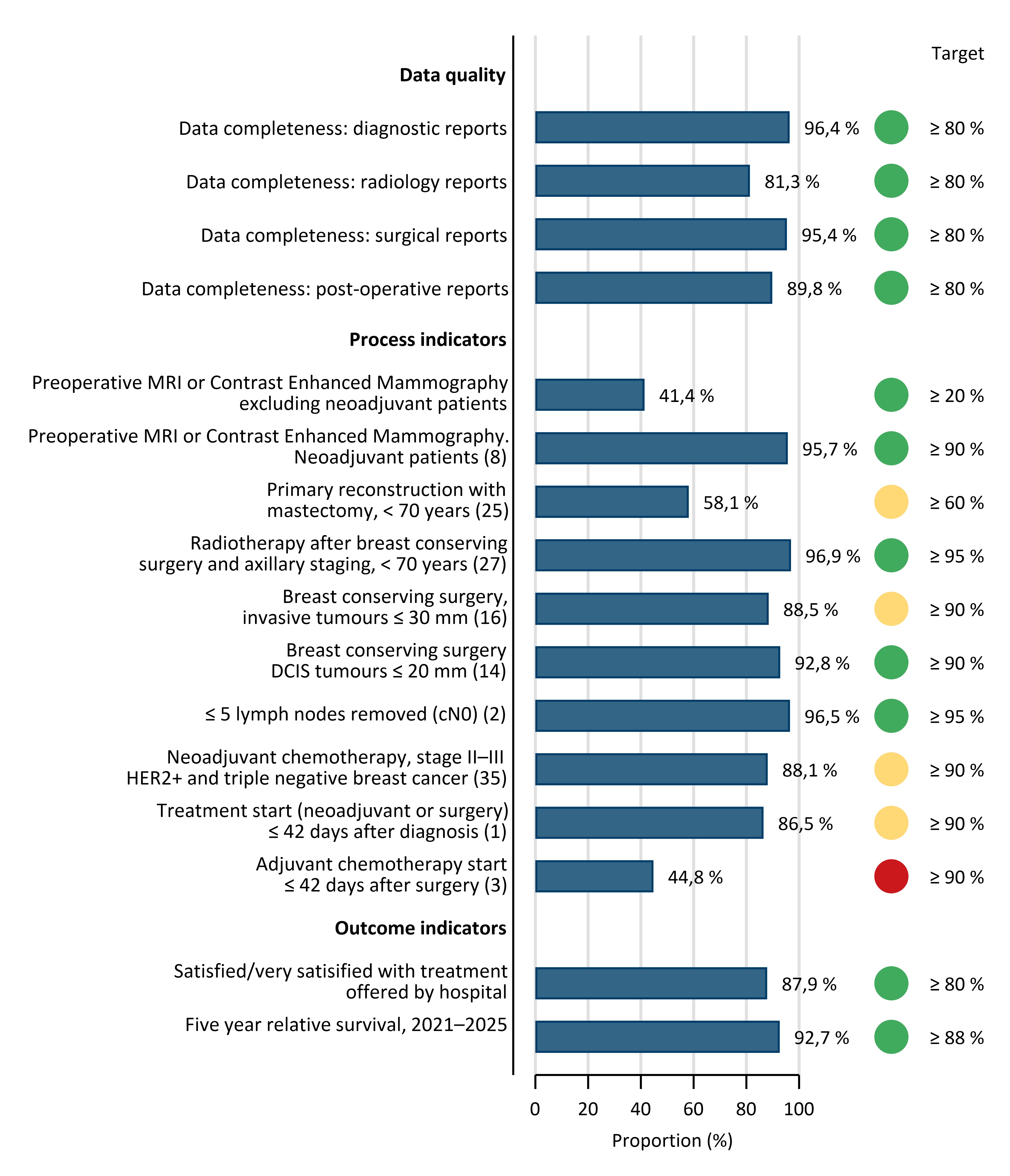
Clinical reports were 96,4 % complete for primary diagnosis, 95,4 % complete for primary surgery, and 89,8 % for the first post-operative check-up. These are all considered to be high levels of goal achievement. For patients with invasive tumors ≤ 30 mm,88,5 %received breast-conserving surgery.
The EUSOMAS target of ≥ 90 % was acheived. There was minor variation in use of breast-conserving surgery between the hospitals, and some hospitals could potentially perform more breast-conserving surgery. For patients diagnosed with ductal carcinoma in situ (DCIS), with a tumor size ≤ 20 mm, 92,8 % received breastconserving surgery during 2022–2024. This was considered a high degree of goal achievement. EUSOMA recommends primary reconstruction for ≥ 60 % of patients < 70 years with DCIS and invasive disease who had a mastectomy without radiotherapy. In 2024, 58,1 % of these patients received a primary reconstruction, which was a moderate goal achievement.
There was reasonably large variation in annual surgical volume between hospitals that conduct breast cancer surgery in Norway. With the increasing complexity of treatment, reducing the number of hospitals diagnosing and treating breast cancer should be considered.
Systemic treatment– special topic of the year
This year’s special topic is systemic treatment. We have focused on patient-directed therapies using immunotherapy, CDK 4/6 inhibitors, and HER2-targeted treatment. Most patients have received these therapies in combination with chemotherapy.
Radiotherapy was given to 96,9 % of patients after breast conserving surgery, which is considered a high goal achievement. Neoadjuvant treatment was given to 88,1 % of patients < 75 years with HER2-positive or triple-negative clinical stage II-III breast cancer, which is considered a moderate target achievement. EUSOMA’s quality target is ≥ 90 %. Use of neoadjuvant treatment varies between hospitals and should be monitored in the years ahead.
Neoadjuvant or surgical treatment was started within 42 days of diagnosis for 86,5 % of patients with stage I-III breast cancer, which is a high goal achievement. EUSOMA’s target tis ≥90%, with moderate target of ≥ 80 %. For patients with triple-negative breast cancer, adjuvant chemotherapy should start within 30 days after surgery, and the professional breast cancer council will follow this recommendation in subsequent reports.
A new quality indicator in this year’s report shows the proportion of women who start adjuvant chemotherapy within 6 weeks after primary surgery, with a median time of 44 days. During the period 2023–2025, 44,8 % of patients started treatment within 6 weeks. Nearly half of the time to treatment initiation was due to waiting for pathology results, which had a median turnaround time of 19 days. EUSOMA’s quality targets recommend that ≥ 90 % of patients start treatment within 6 weeks, with a moderate target of ≥ 80 %.
Patient Reported Outcome Measures (PROM) and Patient Reported Experience Measures (PREM)
PROM results are presented five years after diagnosis for breast cancer patients and controls. Women who have received chemotherapy consistently reported more problems than those who have not, including in daily functioning, fatigue and exhaustion, pain, sexual function and enjoyment, as well as work status and financial situation. The control group—women without breast cancer—reported fewer problems in these same areas.
PREM results are presented 14 months and three years after diagnosis. In 2025, a new quality indicator was introduced: the proportion of patients who were quite satisfied or very satisfied with the services provided by the hospital primarily responsible for treatment. High target achievement is defined as ≥ 80 %, and moderate target achievement as ≥ 70 %. The results show that 87,9 % of Norwegian breast cancer patients were quite satisfied or very satisfied with the treatment services.