Cancer incidence (Indicator 2)
Last update
The indicator describes the following: cancer incidence, by type of cancer, per 100 000 person years.
This indicator is part of Target (1): The original goal was a 25 percent reduction in the premature mortality from cancer, cardiovascular diseases, diabetes, and chronic lung disease from 2010 to 2025. It is now changed to a 33 percent reduction for the period from 2015 to 2030.
Results
In 2024, 38,811 new cancer cases were reported in Norway (20,623 cases among men and 18,188 cases among women). The total number of new cancer cases has increased by 36 percent since 2010 and by 16 percent since 2015.
Random variations in cancer numbers may occur from one year to another. To better understand changes over time, we thus often look at the occurrence over five-year periods. Additionally, the Norwegian population is not only growing, but also aging, which affects cancer statistics. To provide an accurate reflection that considers these demographic shifts, age-standardized incidence rates (Norwegian standard) per 100,000 person-years are used.
Cancer incidence in males
In the last five-year period (2020–2024), there were 678.7 new cancer cases per 100,000 person-years among men. This is a decrease in the incidence rates for all cancer types combined by 3.5 percent compared to both the period 2010–2014 and the period 2015–2019 (Figure 1 and Table 1).
There has been a notable decline in the incidence rates of several major cancer types, including prostate, lung, and colorectal cancers, while skin cancer rates are on the rise.
- Prostate Cancer remains the most prevalent cancer among men since the 1960s, making up 26 percent of all new cancer cases in the period 2020–2024. Its incidence rates have dropped by 9.9 percent compared to 2015–2019 and by 15.7 percent compared to 2010–2014. Prostate cancer is among the cancer sites with the sharpest decline in incidence among male in the past 10–15 years.
- Lung Cancer constitutes 8.6 percent of all new cancer cases. It has experienced a reduction in rates by 10.1 percent compared to the period 2015–2019, and by 16.5 percent compared to 2010–2014, placing it among the cancer sites with the most significant decline.
- Colon Cancer accounts for 7.9 percent of diagnosed cases in the last five years. This cancer site has seen a reduction in incidence of 3.6 percent compared to 2015–2019 and 5.1 percent compared to 2010–2014.
- Melanoma and other skin cancers (mostly squamous cell carcinoma), collectively make up nearly 15 percent of all new cancer cases diagnosed in the last five-year period. Unlike other major cancer types experiencing declining incidence rates, skin cancers have shown a substantial increase, with skin, non-melanoma cancers seeing rates rise by 48.8 percent from 2010–2014 to 2020–2024.
Cancer incidence in females
In the last five-year period (2020–2024), there were 563.6 new cancer cases per 100,000 person-years among women. This is an increase in the incidence rates for all cancer types combined by 7.1 percent compared to the period 2010–2014 (Figure 1 and Table 1).
The five most prevalent cancer sites among women – breast cancer, colon cancer, lung cancer, skin cancer (excluding melanoma), and melanoma – have all seen an increase in incidence rates from the period 2010–2014 to the last five-year period.
- Breast Cancer has been the most common cancer site among women since cancer registration began in the early 1950s, accounting for 22.6 percent of all new cancer cases diagnosed in the latest five-year period (2020–2024). The rates have increased by 13.5 percent from the period 2010–2014, and by 5.4 percent from 2015–2019.
- Colon Cancer represents 9.7 percent of the cases diagnosed in the latest five-year period. While this cancer has seen a slight decline in incidence (-2.0 percent) compared to the 2015–2019, there is a slight increase in rates (2.9 percent) compared to 2010–2014.
- Lung Cancer accounts for 9.6 percent of all cancer cases. There has been an increase in incidence among women, with a peak observed in 2018. The rates for 2020–2024 are 5.4 percent lower than those for 2015–2019.
- Melanoma of the skin and other skin cancers (primarily squamous cell carcinoma) together constitute about 15 percent of all new cancer cases among women diagnosed with cancer in the latest five-year period. Mirroring the trend seen in men, there has also been a significant rise in rates for these cancer types also among women, particularly for skin cancer (excluding melanoma), where the rates have increased by 57.3 percent from 2010–2014 to 2020–2024.
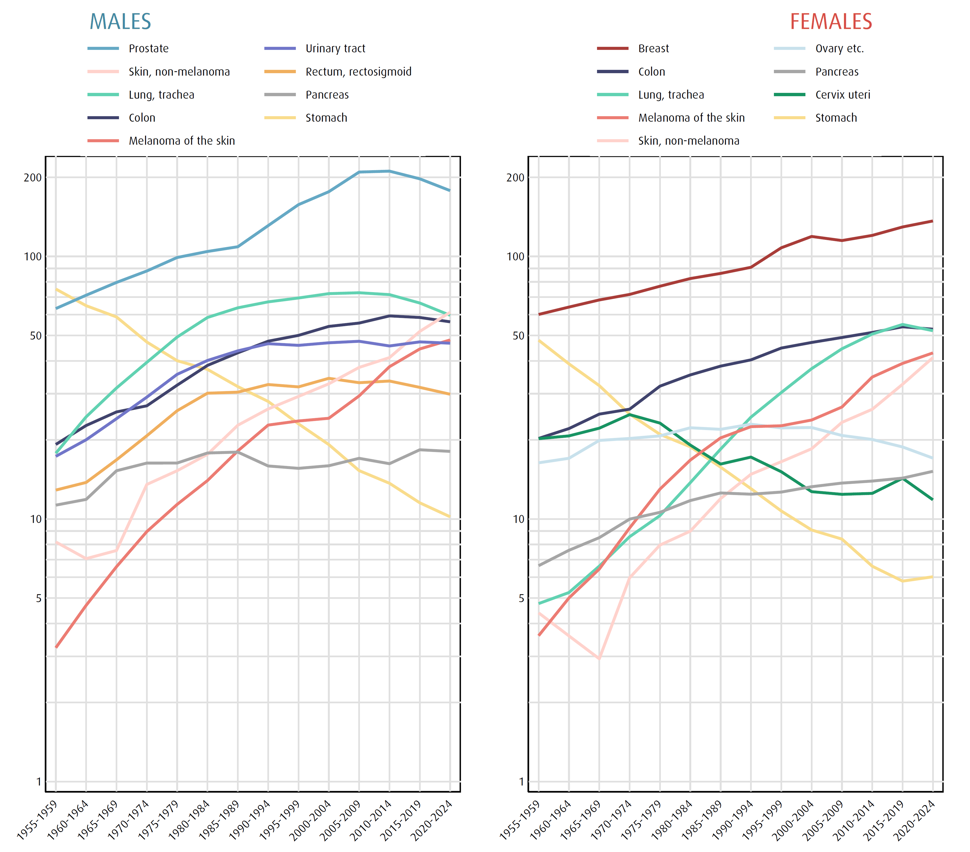
Table accompanying the figures
|
ICD-10 |
Site |
Sex |
2010–2014 |
2015–2019 |
2020–2024 |
Changes from 2010–2014 to 2020–2024 |
Changes from 2015–2019 |
|
C00–96 |
All sites |
Females |
533,3 |
561,1 |
571,2 |
7,1% |
1,8% |
|
C00–96 |
All sites |
Males |
728,4 |
728,6 |
702,9 |
-3,5% |
-3,5% |
|
00-14 |
Mouth, pharynx |
Females |
7,5 |
8,3 |
7,9 |
5,3% |
-4,8% |
|
00-14 |
Mouth, pharynx |
Males |
14,8 |
15,7 |
16,4 |
10,8% |
4,5% |
|
C15 |
Oesophagus |
Females |
2,4 |
2,6 |
2,8 |
16,7% |
7,7% |
|
C15 |
Oesophagus |
Males |
8,5 |
8,8 |
9,1 |
7,1% |
3,4% |
|
C16 |
Stomach |
Females |
6,6 |
5,8 |
6,0 |
-9,1% |
3,4% |
|
C16 |
Stomach |
Males |
13,7 |
11,5 |
10,2 |
-25,5% |
-11,3% |
|
C17 |
Small intestine |
Females |
2,4 |
3,0 |
3,7 |
54,2% |
23,3% |
|
C17 |
Small intestine |
Males |
4,0 |
4,5 |
5,1 |
27,5% |
13,3% |
|
C18 |
Colon |
Females |
51,3 |
53,9 |
52,8 |
2,9% |
-2,0% |
|
C18 |
Colon |
Males |
59,4 |
58,5 |
56,4 |
-5,1% |
-3,6% |
|
C19–20 |
Rectum, rectosigmoid |
Females |
20,3 |
19,1 |
19,2 |
-5,4% |
0,5% |
|
C19–20 |
Rectum, rectosigmoid |
Males |
33,5 |
31,7 |
29,9 |
-10,7% |
-5,7% |
|
C22 |
Liver |
Females |
3,0 |
4,0 |
4,6 |
53,3% |
15,0% |
|
C22 |
Liver |
Males |
6,3 |
8,2 |
8,7 |
38,1% |
6,1% |
|
C23–24 |
Gallbladder, bile ducts |
Females |
3,7 |
2,8 |
3,2 |
-13,5% |
14,3% |
|
C23–24 |
Gallbladder, bile ducts |
Males |
3,6 |
3,2 |
3,1 |
-13,9% |
-3,1% |
|
C25 |
Pancreas |
Females |
13,9 |
14,3 |
15,2 |
9,4% |
6,3% |
|
C25 |
Pancreas |
Males |
16,2 |
18,4 |
18,1 |
11,7% |
-1,6% |
|
C33–34 |
Lung, trachea |
Females |
50,6 |
55,1 |
52,1 |
3,0% |
-5,4% |
|
C33–34 |
Lung, trachea |
Males |
71,5 |
66,4 |
59,7 |
-16,5% |
-10,1% |
|
C43 |
Melanoma of the skin |
Females |
34,7 |
39,1 |
42,9 |
23,6% |
9,7% |
|
C43 |
Melanoma of the skin |
Males |
38,0 |
44,4 |
48,1 |
26,6% |
8,3% |
|
C44 |
Skin, non-melanoma |
Females |
26,2 |
32,6 |
41,2 |
57,3% |
26,4% |
|
C44 |
Skin, non-melanoma |
Males |
41,2 |
51,8 |
61,3 |
48,8% |
18,3% |
|
C50 |
Breast |
Females |
120,3 |
129,5 |
136,5 |
13,5% |
5,4% |
|
C53 |
Cervix uteri |
Females |
12,5 |
14,3 |
11,8 |
-5,6% |
-17,5% |
|
C54 |
Corpus uteri |
Females |
28,2 |
27,7 |
25,1 |
-11,0% |
-9,4% |
|
C56, C57.0–4, C48.2 |
Ovary etc. |
Females |
20,1 |
18,8 |
17,1 |
-14,9% |
-9,0% |
|
C61 |
Prostate |
Males |
211,2 |
197,5 |
178,0 |
-15,7% |
-9,9% |
|
C62 |
Testis |
Males |
12,0 |
11,2 |
10,2 |
-15,0% |
-8,9% |
|
C64 |
Kidney (excl. renal pelvis) |
Females |
9,4 |
10,3 |
9,8 |
4,3% |
-4,9% |
|
C64 |
Kidney (excl. renal pelvis) |
Males |
22,7 |
23,4 |
21,8 |
-4,0% |
-6,8% |
|
C65–68 |
Urinary tract |
Females |
13,9 |
13,9 |
13,7 |
-1,4% |
-1,4% |
|
C65–68 |
Urinary tract |
Males |
45,6 |
47,3 |
46,7 |
2,4% |
-1,3% |
|
C70–72 |
Central nervous system |
Females |
23,4 |
20,8 |
21,0 |
-10,3% |
1,0% |
|
C70–72 |
Central nervous system |
Males |
21,6 |
18,5 |
18,1 |
-16,2% |
-2,2% |
|
C73 |
Thyroid gland |
Females |
9,3 |
11,3 |
12,8 |
37,6% |
13,3% |
|
C73 |
Thyroid gland |
Males |
3,9 |
4,9 |
5,4 |
38,5% |
10,2% |
|
C81 |
Hodgkin lymphoma |
Females |
2,4 |
2,4 |
2,4 |
0,0% |
0,0% |
|
C81 |
Hodgkin lymphoma |
Males |
3,1 |
3,4 |
3,1 |
0,0% |
-8,8% |
|
C82–86, C96 |
Non-Hodgkin lymphoma |
Females |
16,2 |
15,7 |
15,2 |
-6,2% |
-3,2% |
|
C82–86, C96 |
Non-Hodgkin lymphoma |
Males |
22,3 |
22,4 |
21,1 |
-5,4% |
-5,8% |
|
C91–95 |
Leukaemia |
Females |
18,5 |
21,0 |
20,8 |
12,4% |
-1,0% |
|
C91–95 |
Leukaemia |
Males |
27,6 |
30,9 |
28,8 |
4,3% |
-6,8% |
Table 1: Age-standardized (Norwegian standard) incidence rates per 100,000 person-years for selected cancer types, by gender and five-year period, 2010–2024. Source: Cancer Registry's statistics database (https://sb.kreftregisteret.no/). Access date: 16.10.2025.
Read more about cancer in i Cancer in Norway 2024 and Folkehelserapporten: Kreft i Norge (in Norwegian only).
Data source: Cancer Registry of Norway
The data source for this indicator is the Cancer Registry of Norway. A description and definitions follow below.
Description
The Cancer Registry of Norway has information about new cancer cases in the population. Information from clinical notifications, pathology reports and death certificates are the main sources that enable the registry to identify cancer cases. In addition, the Cancer Registry of Norway obtains all C and D codes from the Norwegian Patient Registry and can thus search for missing clinical information for patients who are not registered; the Cancer Registry of Norway is considered to be almost 100 per cent complete. Cancer statistics on incidence, mortality, survival and prevalence are reported in the annual edition of “Cancer in Norway.” Moreover, the NORDCAN database provides information on cancer statistics for the Nordic countries, and global cancer statistics are available from the World Health Organization (WHO) and the International Agency for Research on Cancer (IARC), Cancer Today.
The incidence figures provided here are based on Cancer in Norway 2024 and the Cancer Registry of Norway’ statistics bank.
Links:
Effect measure
The incidence is presented as age-standardised rates per 100 000 person years, and Norway’s population in 2014 (mid-year population in 2014) is used as a weight in the reference population for age-standardisation. The period of measurement is 1955–2024, both genders and all age groups are included.
In age standardisation, the number of new cancer cases per 100 000 person years is adjusted (weighted) in relation to a standard population and expresses the number of new cancer cases such as it would have been if the age composition had been the same as the standard population during all periods. Standardisation is used to enable comparison of rates across populations and time.
|
ICD-10 |
Site |
Comments |
|
C00–96 |
All sites |
Includes the following D-diagnoses: D09, D18, D32–33, D35.2–4, D41–43, D44.3–5 and D45–47. Excludes all basal cell carcinomas of all topographies. Registered codes from ICD-7, ICD-O-2 and ICD-O-3 are converted to ICD-10 using a combination of topography and morphology. As a result, for example neuroendocrine tumours and Kaposi sarcomas are included in the cancer site from which it originated |
|
C00–14 |
Mouth, pharynx |
|
|
C00 |
Lip |
Excludes mucosal tumours of the upper or lower lip (C00.3–5) and mucosal tumours in overlapping sites of the lip (C00.8) |
|
C02–06 |
Oral cavity |
Includes mucosal tumours of the upper or lower lip (C00.3–5) and mucosal tumours in overlapping sites of the lip (C00.8). Excludes soft palate and uvula (C05.1–2) |
|
C07–08 |
Salivary glands |
|
|
C09–10, C01, C14 |
Oropharynx |
Includes soft palate and uvula (C05.1–2) |
|
C11 |
Nasopharynx |
|
|
C12–13 |
Hypopharynx |
|
|
C15–26 |
Digestive organs |
|
|
C15 |
Oesophagus |
|
|
C16 |
Stomach |
Also includes the gastro-oesophageal junction |
|
C17 |
Small intestine |
|
|
C18 |
Colon |
Also includes the ileocaecal valve |
|
C19–20 |
Rectum, rectosigmoid |
|
|
C21 |
Anus |
Excludes the anal margin and anal skin (included in C43.5 and C44.5, depending on morphology) |
|
C22 |
Liver |
Also includes intrahepatic bile ducts |
|
C23–24 |
Gall bladder, bile ducts |
|
|
C25 |
Pancreas |
|
|
C26 |
Other digestive organs |
Excludes peritoneum/retroperitoneum (included in C48) |
|
C30–34, C38 |
Respiratory organs |
|
|
C30–31 |
Nose, middle ear and sinuses |
|
|
C32 |
Larynx, epiglottis |
|
|
C33–34 |
Lung, trachea |
|
|
C38 |
Heart, mediastinum and pleura |
Excludes mesotheliomas (included in C45) |
|
C40–41 |
Bone |
|
|
C43 |
Melanoma of the skin |
Excludes melanoma of skin of genital organs (included in C51–52, C60 and C63) and of the vermillion border of the lip (included in C00.0–2) |
|
C44 |
Skin, non-melanoma |
Excludes skin of genital organs (included in C51–52, C60 and C63) and of the vermillion border of the lip (included in C00.0–2) |
|
C45 |
Mesothelioma |
|
|
C47 |
Autonomic nervous system |
|
|
C48–49 |
Soft tissues |
Excludes mesotheliomas (included in C45). Includes retroperitoneum and peritoneum (C48), but excludes C48.2 for women (included in the group ovary etc.) |
|
C50 |
Breast |
Excludes Pagets disease |
|
C51–58 |
Female genital organs |
|
|
C53 |
Cervix uteri |
|
|
C54 |
Corpus uteri |
|
|
C55 |
Uterus, other |
|
|
C56, C57.0–4, C48.2 |
Ovary etc. |
Excludes borderline tumours and mesotheliomas (the latter is included in C45). In addition to malignant neoplasms, the group includes malignant tumours of the peritoneum (C48.2), fallopian tube (C57.0), broad ligament (C57.1), round ligament (C57.2), parametrium (C57.3), and uterine adnexa, unspecified (C57.4) |
|
C58 |
Placenta |
|
|
C51–52, C57.7–9 |
Other female genital |
Includes melanoma and non-melanoma skin cancers of the genital skin |
|
C60–63 |
Male genital organs |
|
|
C61 |
Prostate |
|
|
C62 |
Testis |
Excludes mesotheliomas (included in C45) |
|
C60, C63 |
Other male genital |
Excludes mesotheliomas (included in C45). Includes melanoma and non-melanoma skin cancer of the genital skin |
|
C64–68 |
Urinary organs |
|
|
C64 |
Kidney (excl. renal pelvis) |
|
|
C65–68 |
Urinary tract |
Includes carcinoma in situ and non-invasive papillary tumours except papillomas (D09 and D41) |
|
C69 |
Eye |
Excludes skin and connective tissue of the eyelid (included in C43.1, C44.1 and C49.0, depending on morphology) and the optic nerve (included in C72.3) |
|
C70–72 |
Central nervous system |
Includes benign tumours (D18, D32–33, and D42–43) |
|
C73 |
Thyroid gland |
|
|
C37, C74–75 |
Other endocrine glands |
Includes benign tumours of the pituitary gland, pineal body and the craniopharyngeal duct (D35.2–4, D44.3–5) |
|
C39, C76, C80 |
Other or unspecified |
Excludes mesotheliomas (included in C45) |
|
C81-96 |
Lymphoid/haematopoietic tissue |
|
|
C81 |
Hodgkin lymphoma |
|
|
C82–86, C96 |
Non-Hodgkin lymphoma |
|
|
C88 |
Immunoproliferative disease |
|
|
C90 |
Multiple myeloma |
Also includes plasmacytomas |
|
C92 |
Myeloid leukaemia |
Includes myelodysplastic syndrome (D46) |
|
C91–95 |
Leukaemia |
Includes polycythaemia vera (D45) and other unspecified tumours in lymphatic or hematopoietic tissue (D47) |
Source: The table corresponds to Table 3.3 in Cancer in Norway 2024 and is reproduced with permission.
National adaptation to global indicators
WHO’s definition of the indicator
Indicator 2. Cancer incidence, by type of cancer, per 100 000 population.
National adaptation
The Cancer Registry of Norway reports national data to the International Agency for Research on Cancer (IARC), WHO. WHO uses the WHO Standard Population when presenting the figures. Due to different data processing methods, there may be some divergence between the data presented above and the data presented by WHO.