Tobacco use among adults (Indicator 10)
Last update
The indicator describes the following: proportion of adults who use tobacco.
This indicator is part of Target (5): 30 per cent reduction in tobacco use from 2010 to 2025.
The indicator covers current daily or non-daily use of tobacco. Tobacco use mainly consists of smoking and the use of snus. We present data on the proportion of adults who regularly smoke, the proportion who regularly use snus, and the proportion who either smoke or use snus regularly. The proportion of daily smokers is shown separately.
Results
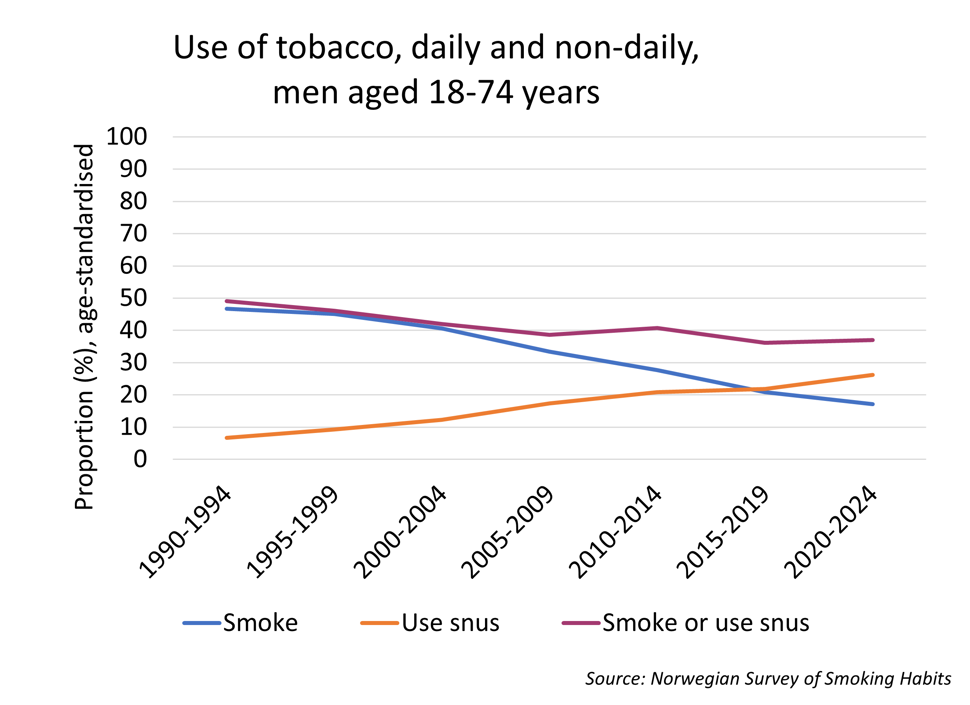
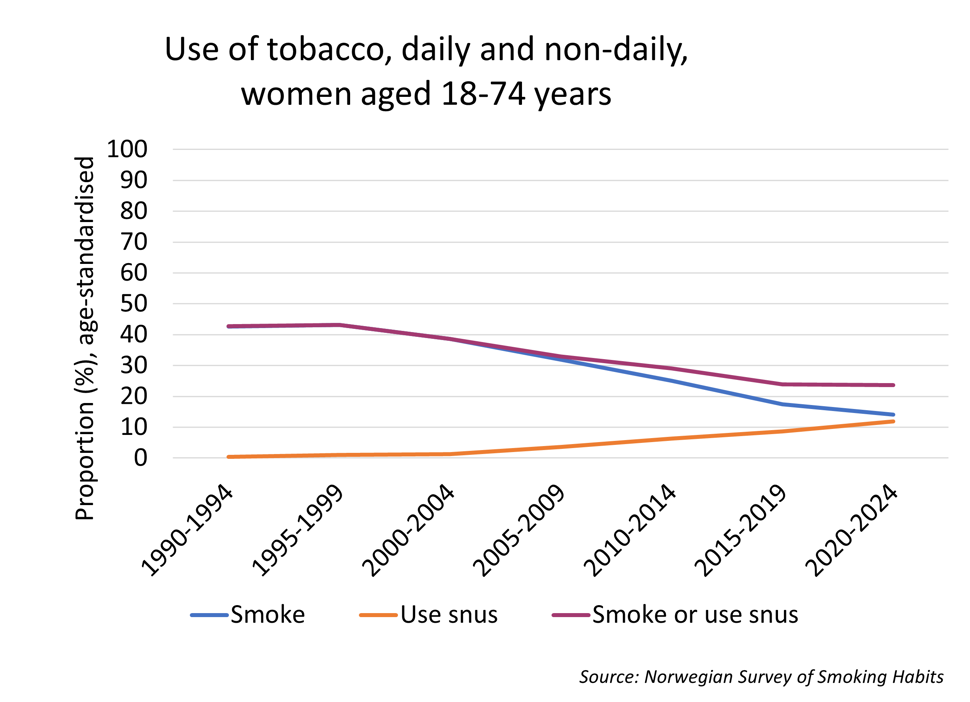
From 1991-1995 to 2021-2025, the percentage who reported smoking (daily or non-daily) fell from under 50 per cent to around 17 per cent among men, and from over 40 per cent to 14 per cent among women, in the 18-74 age group. Towards the end of the period, the proportion who smoked was similar for both genders. The prevalence of daily smoking decreased in the same period from 36 per cent to 8 per cent among men and from 33 to 7 per cent among women.
The decline in smoking coincides with a rise in the use of snus among both genders. The increased use of snus compensated for the decrease in current smoking among men during the period between 2011 and 2025. Among adult women, the use of snus was less widespread and thus there was a stable net reduction in the total proportion reporting that they smoked or used snus up until 2020.
When expressed as a linear trend, the percentage of current smokers among men aged 18 to 74 years decreased 48 per cent from 2010 to 2025. The corresponding decrease among women was 58 per cent. These changes were statistically significant (p<0.05). The decline in the percentage who smoked daily was 65 per cent among men and 70 per cent among women from 2010 to 2025 (p<0.05). The percentage among adults aged 18 to 74 who smoked occasionally decreased 20 per cent among men and 33 per cent among women in the same period (p<0.05).
Using the same approach, the percentage of current snus users among men aged 18-74 increased 44 per cent from 2010 to 2025. Among women the increase was greater, 181 per cent. However, current tobacco use (snus and cigarettes combined) decreased 10 per cent among men and 23 per cent among women aged 18 to 74 years in the period 2010-2025. All changes in current snus use and current tobacco use were statistically significant (p<0.05).
|
Year |
Smoke |
Use snus |
Smoke or use snus |
|
1991-1995 |
47 |
7 |
49 |
|
1996-2000 |
44 |
10 |
45 |
|
2001-2005 |
40 |
14 |
41 |
|
2006-2010 |
32 |
18 |
39 |
|
2011-2015 |
26 |
21 |
39 |
|
2016-2020 |
20 |
23 |
37 |
|
2021-2025 |
17 |
26 |
37 |
|
Year |
Smoke |
Use snus |
Smoke or use snus |
|
1991-1995 |
43 |
0 |
43 |
|
1996-2000 |
43 |
1 |
43 |
|
2001-2005 |
37 |
1 |
38 |
|
2006-2010 |
31 |
4 |
32 |
|
2011-2015 |
23 |
7 |
27 |
|
2016-2020 |
17 |
9 |
24 |
|
2021-2025 |
14 |
13 |
24 |
Data source: Norwegian Survey of Smoking Habits
The data source for this indicator is the Norwegian Survey of Smoking Habits.
A description and definitions follow below.
Description
The Norwegian Survey of Smoking Habits is a telephone-based, nationwide survey of tobacco use (questions about smoking and snus) among individuals aged 16-79, undertaken by Statistics Norway on behalf of the Norwegian Institute of Public Health. The survey has been conducted annually since 1973 and the response rate has been around 60 per cent in recent years, around 70 per cent in the 1990s and around 90 per cent in the 1970s. Since 1985, questions about snus have also been asked.
From 1973 until 1991 the survey was conducted as a supplementary part of the Labour Force Survey. During this period, around 2500 people participated annually. From 1992 until 2020, the survey formed part of Statistics Norway’s Omnibus Survey and Travel Survey. During this period, 2000 people were invited to participate each quarter, except for the second and last quarter of 2015 when 3000 people were invited. The survey was not conducted from the first quarter to the third quarter of 1992, in the first and third quarter of 1994, the third quarter of 1998 and the second quarter of 2000. In 2024 and 2025, the survey was only conducted in the second quarter, but with a larger sample of 8000 people.
- Tobacco in Norway (in Norwegian)
- Norwegian Survey of Alcohol, Tobacco and Drugs (ssb.no) (in Norwegian)
- Norwegian Survey of Smoking Habits (ssb.no)
Numerator
- The proportion of adults in the 18-74 age range who responded that they smoke and/or use snus on a daily or non-daily basis, as a percentage, age-standardised.
Years are stated in five-year groups (1991-1995, 1996-2000, … 2021-2025). These numbers form the basis for the figures and tables.
These figures are described in the Results.
In calculating the figures, changes in the age distribution of the population over time are taken into account in that the figures are standardised to the age distribution of the corresponding population of Norway as of 1 January 2012.
Interpretation and sources of error
In this overview, occasional or non-daily smoking was measured without any constraints (for example having smoked in the past 30 days or having smoked at least 100 cigarettes in their lifetime etc.), thereby including a wide range of smoking intensities. Follow-up questions on the frequency and intensity of occasional smoking show that a large majority of occasional smokers smoked less than once per week and that the number of cigarettes smoked per week has been decreasing over the years. The implication is that even though the percentage of current smokers has increased, the percentage of more frequent smokers, including daily smokers, has decreased sharply over the years.
Data quality
The data quality is deemed to be good, although the response rate has declined over time. In recent years, Statistics Norway has calculated weightings to adjust for deviations from the sample. Using weightings when generating tables has very little effect on the results. However, the sample size will be too small to provide useful responses to questions requiring the sample to be broken down into smaller parts, for example one-year age groups or counties.
Global indicator definition
Indicator 10. Age-standardised prevalence of current tobacco use among persons aged 18+ years.