Total alcohol consumption per capita (Indicator 3)
Last update
The indicator describes the following: Total recorded alcohol sales per capita (aged 15+) during one calendar year, in litres of pure alcohol.
This indicator is part of Target (2): At least 20 per cent reduction in harmful alcohol consumption from 2010 to 2030.
Alcohol consumption can be divided into two main parts. The first is what is often called recorded consumption, that is, consumption recorded by way of alcohol sales at shops, off-licences, cafes, restaurants, bars etc. The second part includes unrecorded consumption derived from a combination of: legal tourist imports and home distillation, legal or illegal border trading, illegal import (smuggling) and illegal home distillation (illicit distilling).
Results
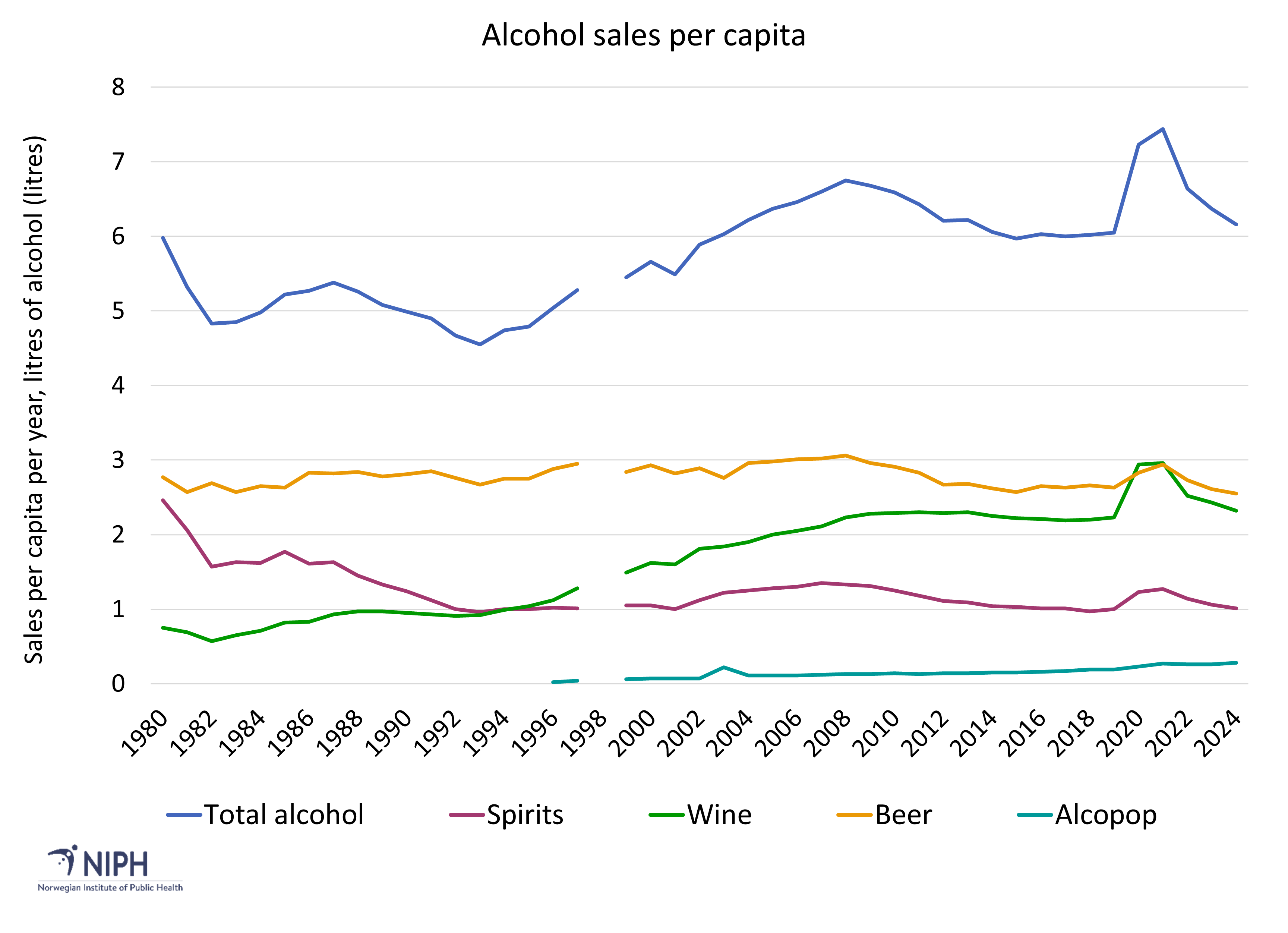
In 2025, the registered alcohol sales fell to 6.16 liters of pure alcohol per capita. The level is now almost the same as in the years before the pandemic. Part of the decline can be attributed to increasing purchases of alcohol abroad and in duty-free shops.
The total alcohol sales per capita, aged 15 and older, remained relatively stable until the mid-1990s, and then there was a sharp increase up to 2008. This can largely be explained by the rise in wine sales. Sales of beer and spirits declined somewhat during the 2010s, resulting in an overall decrease from 2008 to 2014. Sales then stabilized again through 2019.
In 2020 and 2021, registered alcohol sales was clearly higher than in previous years, which can be attributed to measures to limit the spread of COVID-19, especially travel restrictions that meant some of the alcohol purchases by Norwegians shifted from abroad to domestic sales.
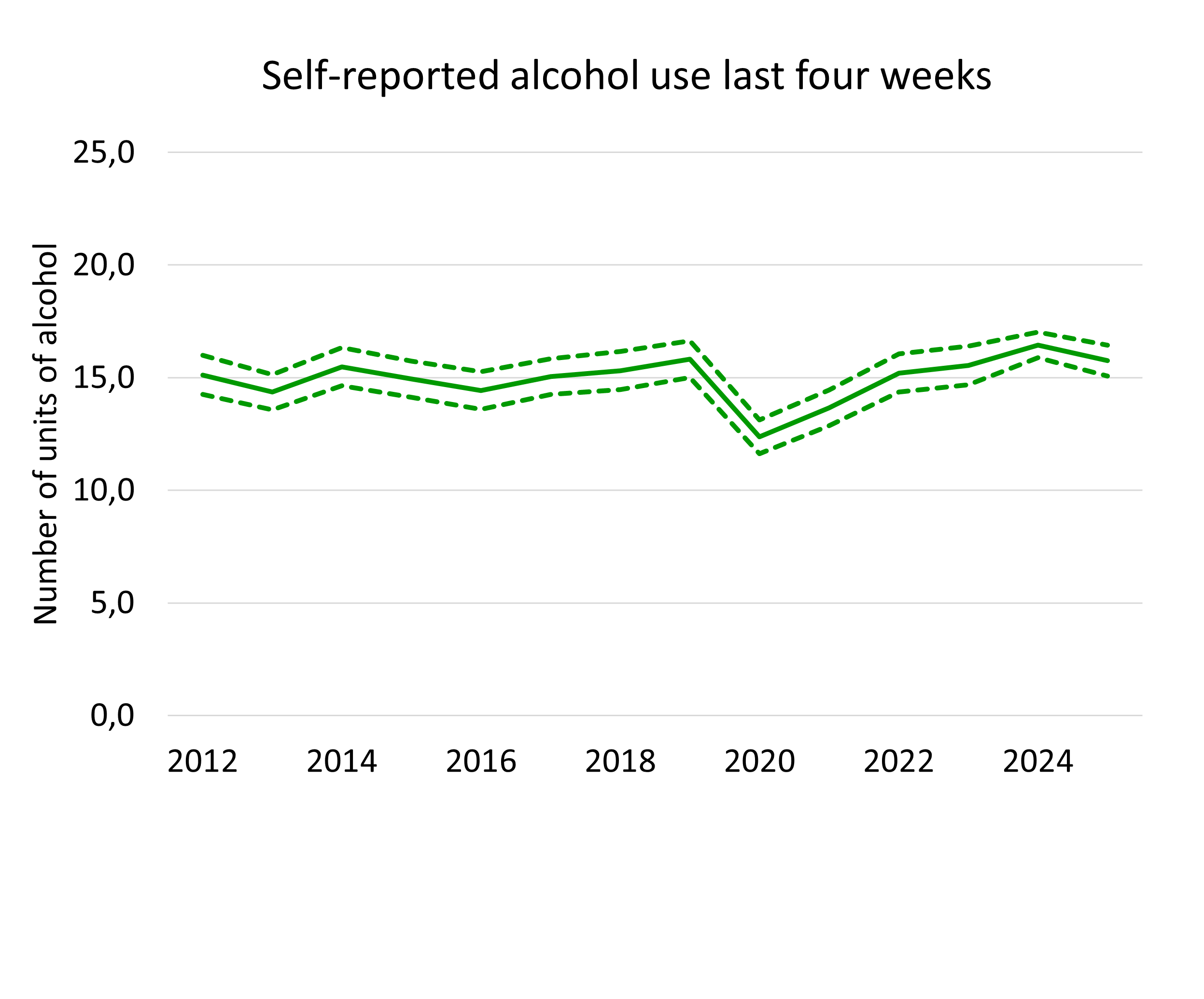
However, results from the population-based Norwegian Survey of Alcohol, Tobacco and Drugs indicated that the average self-reported alcohol consumption for Norwegians aged 16 to 79 years was stable during the years 2012 to 2025, except for the pandemic years 2020 and 2021 when self-reported consumption was lower.
|
Total alcohol |
Spirits |
Wine |
Beer |
Alcopop |
|
|
1980 |
5.98 |
2.46 |
0.75 |
2.77 |
|
|
1981 |
5.32 |
2.06 |
0.69 |
2.57 |
|
|
1982 |
4.83 |
1.57 |
0.57 |
2.69 |
|
|
1983 |
4.85 |
1.63 |
0.65 |
2.57 |
|
|
1984 |
4.98 |
1.62 |
0.71 |
2.65 |
|
|
1985 |
5.22 |
1.77 |
0.82 |
2.63 |
|
|
1986 |
5.27 |
1.61 |
0.83 |
2.83 |
|
|
1987 |
5.38 |
1.63 |
0.93 |
2.82 |
|
|
1988 |
5.26 |
1.45 |
0.97 |
2.84 |
|
|
1989 |
5.08 |
1.33 |
0.97 |
2.78 |
|
|
1990 |
4.99 |
1.24 |
0.95 |
2.81 |
|
|
1991 |
4.90 |
1.12 |
0.93 |
2.85 |
|
|
1992 |
4.67 |
1 |
0.91 |
2.76 |
|
|
1993 |
4.55 |
0.96 |
0.92 |
2.67 |
|
|
1994 |
4.74 |
1 |
0.99 |
2.75 |
|
|
1995 |
4.79 |
1 |
1.04 |
2.75 |
|
|
1996 |
5.04 |
1.02 |
1.12 |
2.88 |
0.02 |
|
1997 |
5.28 |
1.01 |
1.28 |
2.95 |
0.04 |
|
1998 |
|
|
|
|
|
|
1999 |
5.45 |
1.05 |
1.49 |
2.84 |
0.06 |
|
2000 |
5.66 |
1.05 |
1.62 |
2.93 |
0.07 |
|
2001 |
5.49 |
1 |
1.60 |
2.82 |
0.07 |
|
2002 |
5.89 |
1.12 |
1.81 |
2.89 |
0.07 |
|
2003 |
6.03 |
1.22 |
1.84 |
2.76 |
0.22 |
|
2004 |
6.22 |
1.25 |
1.90 |
2.96 |
0.11 |
|
2005 |
6.37 |
1.28 |
2 |
2.98 |
0.11 |
|
2006 |
6.46 |
1.30 |
2.05 |
3.01 |
0.11 |
|
2007 |
6.60 |
1.35 |
2.11 |
3.02 |
0.12 |
|
2008 |
6.75 |
1.33 |
2.23 |
3.06 |
0.13 |
|
2009 |
6.68 |
1.31 |
2.28 |
2.96 |
0.13 |
|
2010 |
6.59 |
1.25 |
2.29 |
2.91 |
0.14 |
|
2011 |
6.43 |
1.18 |
2.30 |
2.83 |
0.13 |
|
2012 |
6.21 |
1.11 |
2.29 |
2.67 |
0.14 |
|
2013 |
6.22 |
1.09 |
2.30 |
2.68 |
0.14 |
|
2014 |
6.06 |
1.04 |
2.25 |
2.62 |
0.15 |
|
2015 |
5.97 |
1.03 |
2.22 |
2.57 |
0.15 |
|
2016 |
6.03 |
1.01 |
2.21 |
2.65 |
0.16 |
|
2017 |
6.00 |
1.01 |
2.19 |
2.63 |
0.17 |
|
2018 |
6.02 |
0.97 |
2.20 |
2.66 |
0.19 |
|
2019 |
6.05 |
1.00 |
2.23 |
2.63 |
0.19 |
|
2020 |
7.23 |
1.23 |
2.94 |
2.83 |
0.23 |
|
2021 |
7.44 |
1.27 |
2.96 |
2.94 |
0.27 |
|
2022 |
6,64 |
1,14 |
2,52 |
2,73 |
0,26 |
|
2023 |
6,37 |
1,06 |
2,43 |
2,61 |
0,26 |
|
2024 |
6,16 |
1,01 |
2,32 |
2,55 |
0,28 |
|
2012 |
2013 |
2014 |
2015 |
2016 |
2017 |
2018 |
2019 |
2020 |
2021 |
2022 |
2023 |
2024 |
2025 |
|
|
Number of alcohol units over four weeks |
15 |
14 |
16 |
15 |
14 |
15 |
15 |
16 |
12 |
14 |
15 |
16 |
17 |
16 |
Data sources
The data sources for this indicator are the Statistics on alcohol sales compiled by Statistics Norway and the Norwegian Survey of Alcohol, Tobacco and Drugs. A description and definitions follow below.
Data source: Alcohol sales
Description
The statistics compiled by Statistics Norway include recorded sales of alcohol and are based on data from the Directorate of Customs and Excise, as well as recorded imports.
Effect measure
- Average reported alcohol sales per person aged 15+, in litres of pure alcohol (alcohol litres) per year.
Unrecorded consumption in the form of home-distilled alcohol, tourist imports, duty-free sales or smuggled goods is not included.
Data source: Norwegian Survey of Alcohol, Tobacco and Drugs
Due to the changes in alcohol sales during the COVID-19 pandemic, the Norwegian Survey of Alcohol, Tobacco and Drugs will serve as an additional data source for this indicator.
Description
The Norwegian Survey of Alcohol, Tobacco and Drugs is a mixed mode nationwide survey of alcohol, tobacco and drug use among individuals aged 16-79, and undertaken by Statistics Norway on behalf of the Norwegian Institute of Public Health. The survey is conducted on a representative sample of people who are selected from the National Population Register and interviewed via telephone or web. The survey enables trends in alcohol use to be traced back to 2012.
- Alcohol in Norway
- Tall om alkohol (hdir.no, in Norwegian)
- Norwegian Survey of Alcohol, Tobacco and Drugs (ssb.no, in Norwegian)
National adaptation to global indicators
WHO’s definition of the indicator
Indicator 3. Total (recorded and unrecorded) alcohol per capita (aged 15+ years old) consumption within a calendar year in litres of pure alcohol, as appropriate, within the national context.
National adaptation
WHO’s indicator applies to both recorded and unrecorded total alcohol consumption per capita per year. The Norwegian indicator only covers recorded alcohol consumption.