
About the choir study
Article
|Published
Is there less airborne transmission among choirs when the singers stand farther apart from each other? We are now recruiting for a pilot study to be conducted in January/February 2026. The purpose of the pilot is to determine whether a larger study can be carried out. You can read more about the pilot study here.
Background for the study
During the COVID-19 pandemic, the authorities advised that people should keep distance between one another. They broadly advised physical distancing, such as keeping 1-2 meters away from one another, and also implemented more specific guidelines and mandates such as increased distance during physical exercise, singing or other activities that could increase the risk of transmission. Collectively, such preventative measures contributed to decreased transmission during the pandemic, but there is still uncertainty around the effects of the individual measures. We need more knowledge on the effect of individual measures to be prepared for future pandemics.
Increased knowledge of the effect of physical distancing may contribute to the continuation of social activities such as choir practices in a safe manner during future pandemics.
We therefore aim to investigate whether physical distancing during choir practices can reduce the risk for respiratory tract infections. In preparation for the main study, we are planning a test project (pilot study), to assess whether a larger study is feasible.
Implementation of the pilot study
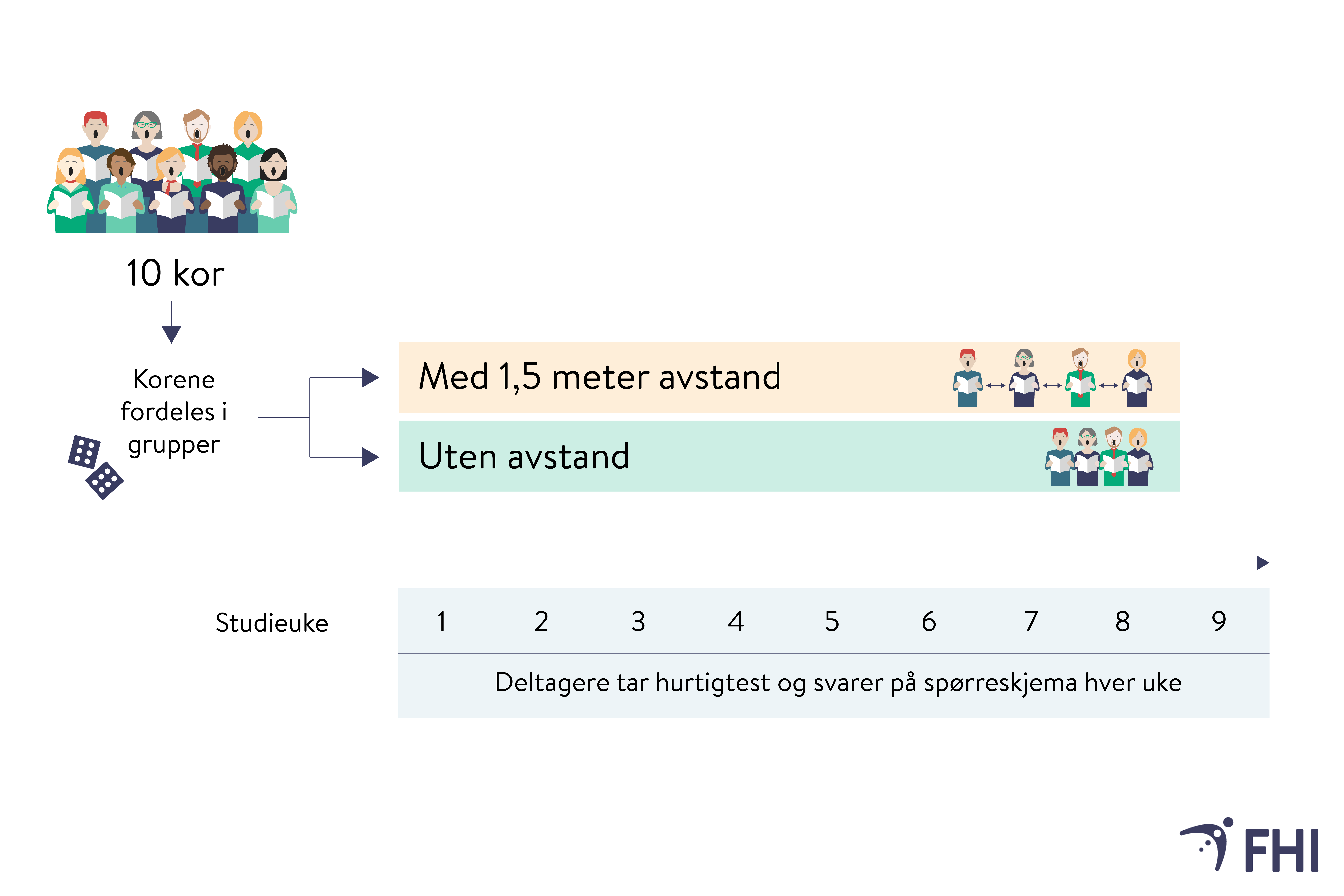
We wish to recruit approximately 10 choirs in the greater Oslo area for a pilot study, which will take place over a 8-week period during the winter of 2026. The choirs should practice at least weekly during the study period and include 15 adult participants or more at each practice. Choirs that participate in the study will be randomly divided into two even groups:
- Distancing group: Choirs in this group will be advised to keep 1.5 meters distance from each other during the choir practice, starting from when they enter the venue and up until the choir practice is finished.
- Control group: Choirs in this group will conduct their practice as usual.
What does the study entail for participants?
The study period lasts for 9 weeks and consists of the following:
- The choir will practice with or without instructions on distancing during the first 8 weeks of the study period.
- You will be asked to fill out a questionnaire ahead of the study period, every week of the study period and after the study period. Each questionnaire takes less than 10 minutes.
In the questionnaire we collect data on:
- Symptoms of common cold or other respiratory infections
- Vaccinations against COVID-19 and influenza
- Whether or not you belong in a risk group for developing severe disease during respiratory tract infections
- Participation in choir practices and if you have followed recommendations for distancing
In addition, we ask that you take rapid tests every week to see if you have been infected with COVID-19, influenza or RSV during the study. If everybody that participates takes a weekly rapid test, we can investigate if increased physical distance reduces transmission.
After the study period is over, the participants will be asked to evaluate their experience of being involved with the study. A subset of participants will also be invited to focus group interviews to give feedback on their experiences so that we can improve the future main study.
We will not be collecting information from registers or other sources, we rely on information the participants submit in the questionnaires themselves. The study entails no increased health risks for the participants compared to their normal activity.
Compensation
As compensation the choir will receive NOK 4000,- in support for funding.
Fixed seating and filming during rehearsals
To assess the relationship between distance from infected choir members and transmission among other participants, we will ask that a selection of the choirs have fixed seating during practice. This means that during practice, participants will be asked to remain in their seat and that they report which seat they are occupying in the weekly questionnaires. Regular seating is voluntary and will only be carried out if everyone in the choir provides their consent.
To assess which distance is actually kept when the distancing instructions are given, we are considering filming or observations for a group of the choirs participating in the study. Detailed plans for filming will be made together with the participating choirs. We will only film in the case where all choir participants have given their individual consent.
Voluntary participation and possibility to withdraw your consent
Participation in the study is voluntary. Participants can withdraw at any time, and choir members who do not wish to answer questionnaires or test themselves can still participate in the choir practices as usual.
Privacy - how we manage your data
We manage your information in a confidential manner in accordance with data protection legislation. Information from questionnaires will be stored directly at Sensitive Data Services at UiO, where data is stored safely and according to approved standards. Only project manager Erle Refsum will have full access to any identifiable data. Publications will not contain any identifiable information. Video material will only be viewed by project members and will be deleted after analysis.
Contact
Contact project manager Erle Refsum tlf. 99 314 576 or email erle.refsum@fhi.no if your choir could be interested in participating in the study or wish to contribute to the planning of the study.